
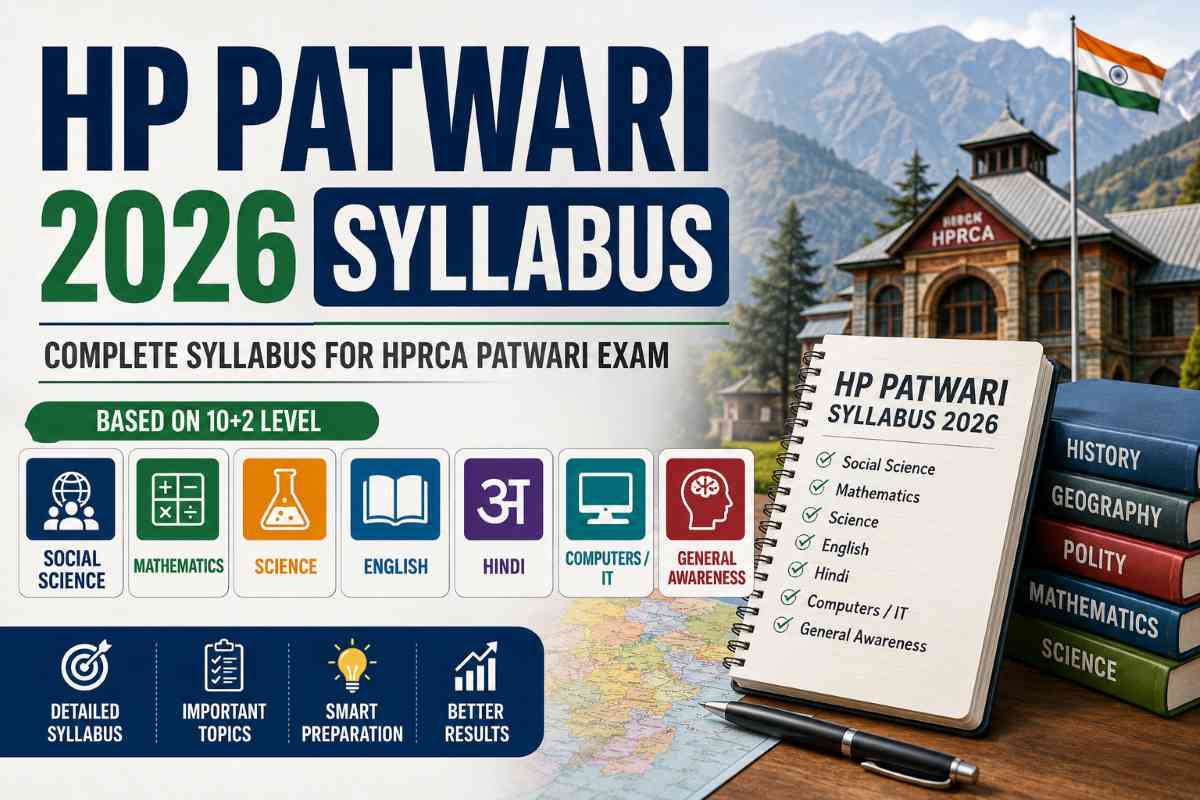
HP Patwari 2026 Syllabus is the complete subject-wise outline for the HPRCA Patwari recruitment exam, covering the topics candidates need to prepare at the 10+2 level. The syllabus includes Social Science, Mathematics, Science, English, Hindi, Computers/IT, and General Awareness, so aspirants should study it carefully before starting preparation. The online application window for the HP Patwari recruitment opened on 12 December 2025 and closed on 16 January 2026.
Part A: Syllabus up to 10+2 Level
1) Social Science
History
Indian History
- Ancient Indian History: earliest societies, hunting and gathering, stone tools, prehistory and human civilization, Paleolithic, Mesolithic, Neolithic, Copper, Bronze and Iron Ages
- Indus Valley Civilization: major archaeological sites, urban planning, trade, arts, industries, crafts, social stratification
- Pre-Vedic and Vedic culture, religious movements
- Mauryan Empire
- Shakas, Kushanas, Satavahanas
- Sangam Age: Cholas, Pandyas, Cheras
- Gupta Age
- Post-Gupta Age and Harshavardhana
Medieval History of India
- Turkish invasions: Muhammad bin Qasim, Mahmud of Ghazni, Muhammad Ghori
- Delhi Sultanate: Mamluk/Slave, Khilji, Tughlaq, Sayyad, Lodi dynasties
- Sufi movement and Chishti order
- Bhakti movement: Shankara, Ramanujacharya, Madhvacharya, Namdev, Gnyaneshwar, Kabir, Guru Nanak, Ravidas, Tulsidas, Surdas, Mirabai, Chaitanya
- Mughal Empire
- Maratha Empire
- Rise of Sikh Empire
Modern History of India
- Arrival of European companies
- Governor Generals of Bengal
- Viceroys of India
- Provincial autonomous states and their conflicts with European trading companies
- Economic impact of British rule
- Land settlement during British rule
- Revolt of 1857
- Social and religious reform movements
- National Freedom Movement, including:
- Indian National Congress
- Partition of Bengal
- Swadeshi and Swaraj
- Muslim League
- Lucknow Pact
- Home Rule League
- Champaran Movement
- Montagu August Declaration
- Kheda Satyagraha
- Ahmedabad Satyagraha
- Rowlatt Act
- Jallianwala Bagh Massacre
- Khilafat Movement
- Non-Cooperation Movement
- Swaraj Party
- Simon Commission
- Nehru Report
- Jinnah Formula
- Bardoli Satyagraha
- Congress Lahore Session
- Dandi March and 11 demands of Gandhiji
- Civil Disobedience Movement
- Round Table Conferences
- Gandhi-Irwin Pact
- Communal Award
- Poona Pact
- Revolutionary nationalist movements of Bhagat Singh, Chandrashekhar Azad, and Subhas Chandra Bose
- Provincial elections in British India
- August Proposal
- Demand for separate Pakistan
- Cripps Mission
- Quit India Movement
- C. Rajagopalachari Formula
- Wavell Plan
- Shimla Conference
- Cabinet Mission
- Mountbatten Plan
Constitutional Development in India
- Regulating Act 1773
- Pitt’s India Act 1784
- Charter Acts of 1793, 1813, 1833, 1853
- Government of India Act 1858
- Indian Councils Acts of 1861, 1892, 1909
- Morley-Minto Reforms
- Government of India Act 1935
- Cripps Mission 1942
- Cabinet Mission 1946
- Indian Independence Act 1947
European History
- French Revolution
- Industrial Revolution
- Unification of Germany
- Unification of Italy
- First World War
- League of Nations
- Russian Revolution and Socialism
- Fascism in Italy
- Nazism in Germany
- Second World War
- United Nations Organization
Geography
- India: size and location, India and the world, India’s neighbours
- Physical features of India: Himalayas, northern plains, peninsular plateau, Indian desert, coastal plains, islands
- Drainage system in India
- Himalayan rivers: Ganga and Brahmaputra river system
- Peninsular rivers: Narmada, Tapti, Godavari, Mahanadi, Krishna, Kaveri basins
- Climate: climatic controls, latitude, altitude, pressure and winds
- Seasons: cold weather, hot weather, advancing monsoon, retreating/post monsoon
- Distribution of rainfall, monsoon as a unifying bond
- Natural vegetation: tropical evergreen, tropical deciduous, thorn forests and shrubs, mountain forests, mangrove forests
- Wildlife
- Population size, distribution, density, growth, and population change
- India’s physical environment, resources and economy
- Resources and development
- Forest and wildlife resources
- Water resources
- Agriculture
- Minerals and energy resources
- Manufacturing industries
- Lifelines of the national economy
- Multipurpose river projects
- Universe and solar system
- Lithosphere and rocks
- Volcano and earthquake
- Landforms: mountains, plateaus, plains
- Agriculture and food crops
- Cropping pattern
- Forests and types of forests
- Minerals
- Sources of power/energy
- Industries and occupations
- Transport and communication
- Rainwater harvesting
- Land use pattern in India
- Land degradation and conservation measures
- Types of farming: primitive, subsistence, intensive subsistence, commercial
Economics
- Development, goals of development, national development, comparison of countries/states
- Public facilities
- Sustainability of development
- Sectors of Indian economy: primary, secondary, tertiary
- Organized and unorganized sectors
- Public and private sectors
- Money and credit
- Money as medium of exchange
- Modern forms of money
- Loan activities of banks
- Credit situations
- Terms of credit
- Formal sector credit in India
- Self-help groups
- Globalization and the Indian economy
- Production across countries
- Foreign trade and integration of markets
- WTO
- Impact of globalization in India
- Fair globalization
- Consumer rights
- Food security in India
- Poverty challenges
Political Science
- What is democracy and why democracy
- Constitutional design
- Democratic constitution in South Africa
- Indian Constitution and its values
- Electoral politics
- Working of institutions
- Parliament
- Political executive
- Judiciary
- Democratic rights
- Constituent Assembly
- Preamble of Indian Constitution
- Fundamental Rights and Duties
- Directive Principles of State Policy
- Parliament and its two houses
- Prime Minister and Council of Ministers
- Judiciary at national, state and local level
- President, Vice-President, Governor, Chief Minister
- State legislative assemblies
- Citizenship
- Centre-state relations
- Emergency provisions
- Major constitutional amendments from 1951 onwards
- Budget
- Election Commission of India
- Local self-government: Panchayats and Municipalities
- Political parties
- Finance Commission
- Comptroller and Auditor General of India
- Attorney General of India
- Anti-defection law
- Official language
- CBI
- Caste
- Patriarchy
- Planned economy
- Social movements
- Power sharing: Belgium and Sri Lanka
- Federalism
- Decentralization in India
- Gender, religion and caste
- Outcomes of democracy
2) Mathematics
- Number systems, place value, face value
- Indian and international numeration systems
- Reading, writing and comparing large numbers
- Number line, estimation, rounding
- Natural numbers, whole numbers, integers
- Prime and composite numbers
- Factors and multiples
- Divisibility tests
- HCF and LCM
- Rational numbers, irrational numbers
- Real numbers and their classification
- Laws of exponents
- Fundamental theorem of arithmetic
- Fractions, decimals, percentages
- Squares, square roots, cubes, cube roots
- Operations on whole numbers and integers
- Properties: commutative, associative, distributive
- Rules of signs, absolute value
- Word problems
- Algebraic expressions, factors and identities
- Polynomials
- Linear equations in one and two variables
- Graphical method
- Pairs of linear equations
- Quadratic equations
- Arithmetic progression
- Ratio, proportion, variation
- Basic geometry: points, lines, angles, parallel lines, Euclid’s axioms and postulates
- Triangles: congruence, similarity, Pythagoras theorem
- Quadrilaterals and polygons
- Circles and related areas
- Constructions
- Measurement: area and perimeter
- Surface areas and volumes
- Coordinate geometry
- Introduction to trigonometry
- Heights and distances
- Statistics and data handling
- Probability
- Work and time
- Mensuration
- Exponent of power
- Direct and inverse proportion
- Factorization
- Time and distance
3) Science
- Components of food
- Sorting materials into groups
- Separation of substances
- Getting to know plants
- Body movements
- Living organisms, characteristics, and habitat
- Motion and measurement of distances
- Light, shadows, and reflections
- Electricity and circuits
- Fun with magnets
- Air around us
- Nutrition in plants
- Nutrition in animals
- Heat
- Acids, bases and salts
- Physical and chemical changes
- Respiration in organisms
- Reproduction in plants
- Motion and time
- Electric current and its effects
- Light
- Forests, water, sewage and wastewater treatment
- Crop production and management
- Microorganisms: friend and foe
- Coal and petroleum
- Combustion and flame
- Conservation of plants and animals
- Reproduction in animals
- Reaching the age of adolescence
- Force and pressure
- Friction
- Sound
- Chemical effects of electric current
- Some natural phenomena
- Matter in our surroundings
- Elements, compounds, mixtures and solutions
- Atoms and molecules
- Structure of atom
- Fundamental unit of life
- Tissues
- Improvement in food resources
- Motion, force and laws of motion
- Gravitation
- Work and energy
- Chemical reactions and equations
- Metals and non-metals
- Carbon and its compounds
- Life processes
- Control and coordination
- Heredity and evolution
- Light: reflection and refraction
- Human eye and colourful world
- Electricity
- Magnetic effects of electric current
- Our environment
4) English
- Reading comprehension
- Word power
- Sentence
- Subject and predicate
- Articles
- Number
- Gender
- Punctuation
- Noun
- Pronoun
- Verb
- Finite and non-finite verbs
- Adverb
- Adjective
- Preposition
- Conjunction
- Interjection
- Error correction
- Sentence rearrangement
- Vocabulary
- Antonym and synonym
- Tenses
- Subject-verb agreement
- Idioms
- Modals
- Active voice and passive voice
- Direct and indirect narration
- Phrases and clauses
- One-word substitution
- Transformation of sentences
5) हिन्दी
- भाषा, व्याकरण एवं लिपि का परिचय
- वर्ण विचार एवं अक्षरिक खंड
- शब्द विचार
- शब्दों के प्रकार: तत्सम, तद्भव, देशज, विदेशी
- संज्ञा, सर्वनाम, क्रिया, विशेषण
- क्रिया-विशेषण, संबंधबोधक, समुच्चयबोधक, विस्मयादिबोधक
- पद परिचय
- शब्द शक्तियाँ
- शब्द रूपांतरण: लिंग, वचन, कारक, काल, वाच्य
- संधि, समास, उपसर्ग, प्रत्यय
- वाक्य विचार
- अर्थ विचार: पर्यायवाची, विलोम, वाक्यांश के लिए एक शब्द, समानार्थी
- विराम-चिह्न
- शुद्धिकरण: शब्द शुद्धि, वाक्य शुद्धि
- मुहावरे और लोकोक्तियाँ
- अलंकार
6) Computers / Information Technology
- Fundamentals of computer
- Components of computer
- Operating system
- Troubleshooting and utilities
- Computer networking
- Internet and its terminology
- Cyber threats and cyber security
- Word processing
- Spreadsheet
- Presentation
- E-governance
- MIS
Part B: General Awareness
- General knowledge
- General knowledge of Himachal Pradesh
- Current affairs
- Everyday science
- Logical reasoning
- Hindi (Matric standard)
- English (Matric standard)
HP Patwari 2026 Syllabus gives candidates a clear roadmap for exam preparation and helps them understand exactly what to study before the test. According to the official HPRCA syllabus, the exam is based on the 10+2 level and includes major subjects such as Social Science, Mathematics, Science, English, Hindi, Computers/IT, and General Awareness. This means aspirants should not study randomly, but should follow a planned approach and give equal attention to both conceptual topics and revision.
A good preparation strategy should focus on basic maths, grammar, Himachal Pradesh GK, current affairs, and science fundamentals, because these areas are highly useful for scoring well. The syllabus also shows that the exam is meant to test practical understanding along with general knowledge, so regular practice of previous questions and topic-wise revision can make a big difference. In short, understanding the HP Patwari 2026 Syllabus properly is the first and most important step for smart preparation, because it saves time, reduces confusion, and helps candidates study with more confidence and direction.
FAQs for HP Patwari 2026 Syllabus
1. What is the level of the HP Patwari 2026 syllabus?
The HP Patwari 2026 syllabus is based on the 10+2 level and includes subjects like Social Science, Mathematics, Science, English, Hindi, Computers/IT, and General Awareness.
2. Which subjects are included in the HP Patwari 2026 syllabus?
The syllabus includes:
- Social Science
- Mathematics
- Science
- English
- Hindi
- Computers/Information Technology
- General Awareness
3. Is Himachal Pradesh General Knowledge included in the syllabus?
Yes, General Awareness includes General Knowledge of Himachal Pradesh, current affairs, everyday science, and logical reasoning.
4. Does the HP Patwari syllabus include Computer Knowledge?
Yes, candidates have to prepare topics like computer fundamentals, operating systems, MS Office tools, networking, internet basics, cyber security, e-governance, and MIS.
5. Are current affairs important for the HP Patwari exam?
Yes, current affairs are an important part of the General Awareness section and candidates should regularly follow national and Himachal Pradesh current events.
6. Is the Mathematics syllabus difficult in HP Patwari 2026?
The Mathematics section is mainly based on basic to moderate level topics such as algebra, trigonometry, geometry, statistics, percentage, ratio, time and distance, mensuration, and probability.
7. Does the HP Patwari syllabus include History and Geography?
Yes, Social Science includes Indian History, Medieval and Modern History, European History, Indian Geography, Economy, and Political Science.
8. Is English grammar important for the HP Patwari exam?
Yes, the English section includes grammar and vocabulary topics like tenses, narration, voice, sentence correction, comprehension, idioms, synonyms, antonyms, and subject-verb agreement.
9. What topics are covered in the Hindi section?
The Hindi syllabus includes व्याकरण, संधि, समास, अलंकार, मुहावरे, लोकोक्तियाँ, वाक्य शुद्धि, शब्द शुद्धि, पर्यायवाची, विलोम, and other grammar topics.
10. When was the HP Patwari 2026 application form window open?
The online application process for HP Patwari recruitment started on 12 December 2025 and closed on 16 January 2026.
11. Is the official HP Patwari syllabus released by HPRCA?
Yes, the official syllabus has been released by HPRCA along with the recruitment details.
12. How should candidates prepare for the HP Patwari 2026 exam?
Candidates should first complete the official syllabus, revise basic concepts regularly, practice previous year questions, and focus on Himachal Pradesh GK and current affairs daily.
See more
1 thought on “HP Patwari 2026 Syllabus Download”